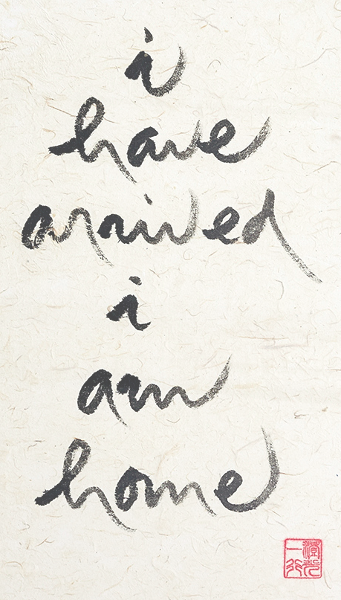
Waking up in the morning is nothing special: the sunlight looks in your window, and you open your eyes. You don’t need to think about it. You might take a deep breath, and stretch your arms and legs. Then you stand and begin to move into the day.
Awakening to mindfulness is as simple and as natural as waking up. We open our eyes, and see what we are looking at. We hear what we are listening to. Sometimes we try to do many things quickly, or at the same time, so giving attention to seeing and hearing is more difficult. It helps to practice slowing down.
We can also smell the air we are breathing, taste the food we are eating, and feel what we are touching. We can know what we are thinking, and notice the people and environment around us. This is the nature of our senses and is available to us all the time. When we stop for a moment and meet what is taking place within and around us, we create peace within ourselves. It’s like opening your eyes to a sunrise.
People who live in monasteries carefully remove as many distractions as possible from the day. They work together to create a lot of stillness, so it is easier to stop and be present. In our households and in our work, where family members and colleagues are not always at peace, there is much more noise, and many details that ask for our attention. We have many opportunities to practice hearing what we are listening to!
Friends Along the Path
With good guidance and with practice, we can become more skillful in navigating the less peaceful and less quiet parts of our day. It helps to have a place outside the home and a regular schedule. It’s like returning to bed so we can open our eyes again, and stretch and feel the floor underfoot again. As a breath with awareness invites us back to the present moment, the refuge we create with Sangha supports a return to shared values. In
Thích Nhất Hạnh’s teaching, these values are described in the Five Mindfulness Trainings and the Fourteen Mindfulness Trainings.
Each season, we set a schedule with our friends along the path, the members of the community. Each time we meet, one member will hold the space, so that other members or guests may accompany and rest in the practice.
A House of Mindfulness
To experience some of the peace that is created by the monks and nuns in the monastery, we build a house for mindfulness through regular, shared practice. Each session we will embrace the Three Dharma Seals of impermanence, the lack of separate self and moving beyond notions, and will include seven elements of practice:
Continuation from action to stillness
from the noise of the daily to the stillness of Sangha
The stillness we cultivate together is not separate from the business of living. Sleep leads to waking, waking to walking, walking to working, one step to the next; and from work or family or rest we bring ourselves back to the community circle. It takes some minutes to gather. The latest traffic-jam or rain storm makes our way slippery. We practice being aware at each step from where we have been, to where we will be. We try to breathe and stop early, so our walk to the circle is easy, light and restful. We find a space and sit in silence, helping our friends arrive to a space full of light and open hearts.
A seed of the Dharma for individual practice
a reading from our Root Sangha helps focus the mind
Our teachers have refined their words over many years of reflection and practice. Those words are not a destination, but skillful means to transform habits of thought and of being. This seed could be the focus of meditation, or simply the fragrance of the Dharma in the air while we sit. If a phrase brings light to the heart, that lightness of heart enters the world as a smile, and our practice becomes both solid and free.
Seated meditation
practicing presence, we find sanctuary in our true nature
Our senses are touched in so many ways in our waking lives. In seated meditation we create refuge, a sanctuary of breath and of healthy habit, that remain with us even when we open our eyes and begin our work. We choose seated medititation to deepen and root our practice, so that the trunk remains strong and the branches reach high.
Community circle
solid and free, we share our lives since last we met
With quiet minds we open our hearts to one another. Speaking carefully and listening deeply, we share what is present in our lives without the emotional wind that often accompanies our words. Speaking from a place of peace is itself a nourishing practice. We carry this habit of conscious communication back to our families and work relationships.
A seed of the Dharma for engaged practice
a reading from our Root Sangha to guide our steps
The lineage of
Thích Nhất Hạnh holds community engagement as its highest aim, and as Buddhism’s most fruitful harvest. Skills learned and practiced are never for oneself; as our lives are an interconnected whole, one healing word heals the world. A phrase or idea from the Dharma can shine a light on the world without as brightly as it does the world within.
Engaged meditation
practice with the senses engaged prepares us for the world
Our teachers and teachings offer guidance for bringing these practices to life, not only in a meditation hall or in a monastery, but more importantly in our schools and offices and communities as well. The skillfulness we learn in seated meditation can make its way into our everyday activities. To give peaceful being a path into the noisy parts of our day, we invite our senses and awareness to be present in engaged meditation practice.
Continuation from stillness to action
let the stillness of sangha inform our daily activities
The stillness we cultivate together is not separate from the business of living. From the community circle, awakening leads to rising, rising to walking, walking to working, one step to the next. We practice bringing awareness to each step from where we have been to where we are, to where we will be. We try to breathe and stop regularly, so the walk of life is easy, light and restful. We invite spaces to sit in silence, and help our friends and families live in a space full of light and open hearts.
Gardening Tools
You might consider your life as a garden, and the practice of mindfulness as the art of gardening. You are the gardener. Maybe you are the flower, and the fruit, too. If I am to be a fruit, I prefer sweet and ripe over bitter. I will weed and water so that the garden is healthy and the harvest is plentiful.
Gardening has been practiced for a long time. In the Buddhist Dharma, we take up gardening tools that teachers and students have skillfully used for hundreds and hundreds of years, to make our work light.
Some of the texts used for regular sessions will be saved in the Teachings area of the Falling Rain website.















 Add bookmarks from the pages that you visit frequently. They will appear here, where you can reorder them, and put them into groups.