














 Add bookmarks from the pages that you visit frequently. They will appear here, where you can reorder them, and put them into groups.

Facilitation: From I to We

From I to We
The verb to facilitate literally means “to make easier”. When we facilitate a gathering of the Sangha, we are making the way lighter for our companions.
The Better Way to Draw a Circle
A circle exists before you draw it. It is there, in the ink of your pen; it is in your hand, and in the muscles of your arm. There is a circle in your sight and in your mind, and even a circle in the seeds of consciousness that are stored in you. When you draw a circle, you are not separate from it. You are not creating something from nothing. You are the circle, together with paper, ink, cells of your body, thought, air, and time.
It is better to listen for the circle, and allow it to be written from all of its elements. Even though your hand is moving, there is no effort, because you don’t have a preconceived notion of what that circle is supposed to be. Maybe your circle is an oval, or an egg. Maybe it is a square! That would be real freedom.
When you are facilitating a group, you can rest in the form it is becoming, without having to care for anything but your own mindful actions. If you have a bell, you might invite it… or not. If you feel that your voice can be refreshing and comforting for the community, sing or offer guided meditation… or sit silently, mindfully, and offer your smile. As facilitators, we can rest in the way of Plum Village practice.
Mindful of Privacy
For the most part, our regular activities take place on line. Because of this, the way in which we connect with one another – internet connections, with cameras and voice – is from the intimacy of our own homes.
We practice being as skillful as possible with this offered intimacy. In the Second Mindfulness Training for lay practitioners, we are “determined not to steal and not to possess anything that should belong to others.” In our practice together, what belongs to others includes their personal stories, their digital voices and their image on the screen. We should be conscious of and careful with these belongings. When facilitating, we might remind the gathered community from time to time.
- Dharma Sharing: stories that have been offered in confidence, in the safety of the community circle, should never be shared. A person’s story is their story. The safety of the circle ends where gossip begins. If personal stories can no longer be shared in confidence, the community loses an essential space for processing difficult emotions and challenging life events.
We can share our story, however: the feelings and the mental formations that arise in us when we hear deeply human confidences allow us to reflect and process our own suffering. We can tell our own truth without reference to an individual or their precious personal details. - Images and screenshots: Our meetings are personal, if not private. Most people are uncomfortable having their picture shared. It compromises the sense of security, and intrudes on individual privacy.
- Sound and video recordings: technology also makes it easy to capture sound and video. We cultivate true security in our community by never capturing a speaker’s words or presentation.
There may be a time when we choose to record guided meditations or dharma teachings, in video or audio format. For example, we might consider recording chants, so that those who are studying them or practicing alone might have the company of community voices. In any of these cases, the person speaking or the chorus chanting would be invited to participate.
Facilitation tools
Online materials @FallingRain.org
Most all you might need for a nourishing Chant or Dharma Sharing is available here on the web site. If you prepare a little bit before the start of a meeting, you can facilitate with joy and ease in your heart. When we are holding the space for our practice community, Joy and ease are one of the simplest and greatest gifts we can offer.
For Chanting, you might like to play a Plum Village song or chant prior to the sitting:
- The Avalokiteśvara Chant (19:26) can be played in part
- Invoking the Bodhisattvas (4:52)
- May the Day Be Well (4.29)
- Praising the Buddha (4:44)
- The Three Refuges (2:43)
It makes the mind happy to learn these chants, and we learn them by singing them. You might wish to play it and sign along, or simply sing at your own pace and for the benefit of community.
You can also play or sing the Morning Chant (4:49) and the Evening Chant (5:27). When you begin the chant on the hour, the community is usually finished about six minutes later.
Online materials @PlumVillageApp
While we try to include words and links to our favorite chants and songs, there may be new favorites that we haven’t found yet, or other expressions of familiar words that we might share. The Plum Village App is a great resource for all kinds of digital material from our root Sangha. We are able to play and share most of the audio and video by searching the App’s online library. The library is organized in three main sections for Meditations, Talks and Other Resources.
Online meetings software (Zoom)
- Edit your Personal Profile to include a picture of yourself. In this way, you are visually present in the community circle even when your camera is off line. Look for a picture that feels fresh, with a smile, that can water the seeds of happiness in your companions.
- PLEASE NOTE: for some of the following settings to be visible, you may need to install the Zoom application on your computer, and connect to meetings using the program instead of using the web page.
- For facilitators, consider updating your Zoom audio settings so that Noise Reduction is set to low. On some platforms, this is described as Use Original Sound. This setting allows the sound of a bell or chime to be reproduced with greater fidelity, and the quieter ends of its ringing will not be cut off. Care should be given that your space does not have too much ambient noise that would distract from sessions. Set your microphone to mute when sitting in meditation.
- The chat window can be used to share lyrics to songs or Mindfulness Trainings. There is a limit to how much text can be pasted, so you might have to send portions of a reading separately. PLEASE NOTE: only participants who are on line when you send a chat will receive it. Either wait until all are in attendance before clicking send, or copy and paste a second time, if other participants arrive later.
- You can share your screen, and optionally share computer audio only (via the Advanced button and the sharing dialog), so that a song you share from YouTube might arrive with high fidelity to the other participants. PLEASE NOTE: If you decide to share audio, please perform a sound-check with someone prior to the sitting, as the volume that you hear may be different than what the listener hears. You also should ask participants to mute their microphones before sharing sound, as otherwise there might be noise on the line.
- Hot-keys can make meeting management easier. If you are the meeting host, you can mute and unmute your audio with ctrl-A; when someone has left their microphone open, you can mute all participants except yourself with ctrl-M. Pressing ctrl-H shows and hides the chat window. If you have not already been included as a regular “alternate host” of a meeting, ask the meeting owner or another Sangha “host” to connect you.
Meetings do not have a fixed time. You may wish to practice facilitating a meeting, at a time when other events are not scheduled. Ask one or two of your Sangha companions to meet with you, to listen to your Zoom setup and bell, and to help you practice using the Zoom tools.
Activity timers
You will feel more at ease when you use a small timer for some of the meeting activities. Particularly when sitting for a fixed period of time, a small timer can allow you to participate, instead of watching the clock. You might use a timer on the computer or handheld device you use for Zoom, or a separate timer on your watch or mobile phone. Look for a simple, repeatable method that can allow you to remain in the present moment, holding the space for the Sangha with ease and with grace.
- An alarm or countdown timer that rings once, without the need for intervention to turn it off, is most useful. A visual alert on your Zoom device may be least intrusive.
- Some meditation timers, including the one included in the Plum Village App, have pleasant chimes to conclude a meditation. It might be loud enough to open and close a meditation for the meeting participants.
- If you prefer to invite a bell yourself, you can use an earphone to hear a timer alert, so it isn’t heard by the other participants. You might also turn down the speaker volume if the timer is on your Zoom device, or keep your microphone muted.
Facilitation guides
More that a logistical service to the Sangha, facilitation by our members makes the community so much richer. Everyone benefits by the nuances of voice and thought that each one of us brings to the circle. It brings happiness when one can sit and receive the sound of someone else’s bell, whether it be a bell made of bell metal, or the bell of the voice, or the bell of the heart.
Below are some ideas for our main events. These suggestions may change over time, as members bring more voices and ideas to our gatherings.
Morning and Evening Chant
The morning and evening chants are little islands or oases of peace. We can enjoy twice a day, every day, and in doing so we begin to live more quietly and mindfully. With so many opportunities to facilitate, our Sangha offers a wonderful way to bring the practice of the Dharma into one’s life. Embracing one or more events each week and making them “your day” is most beneficial to the facilitator’s practice and to the community. We add the facilitator’s initials to the calendar, and the Sangha Body can relax in the knowledge that day is accompanied.
The chant meetings have three or four parts:
Five minutes (or more) before the chant is to begin, the facilitator starts the meeting as host. She or he can water the seeds of stillness and peace, by playing a chant or singing a song, or by inviting the bell, perhaps once a minute. If you invite the bell, you might like to follow one of the Invitations to Presence, speaking them silently or out loud before each invitation of the bell.
Finish the period of arrival some seconds before the hour, so you can prepare to sing or play the chant for the assembled community, either at 07:00 or 22:00.
You can sing the Morning Chant or the Evening Chant – it is wonderful to hear the voice of our Sangha Body – or you might play it from the web site, or simply recite it. The chant is just a form, yet a useful one, into which the community can settle when they begin or end their day.
In some of the recorded chants, we hear and can accompany community voices during the call-and-response at the end. Others simply provide silence which we can fill with out own voices. Those with silence have times listed, for when the bell is invited. Listening to our community singing, we can pause the audio to allow the response to finish, and start it to allow the bell to ring once they are done.
On Mondays, Wednesdays and Fridays, we include a guided meditation in our morning and evening sittings. Since we sit for only 15 minutes after the chant, choose the short form of your selected meditation, so there is space for you as facilitator to relax into the breath. There are links in the text about meditations to switch between the short and the long form.
Before we read each passage, we awaken the bell with a quiet, muffled tap. Doing so, the hearts and minds of the meditators are not surprised, and are present to hear the words of the Dharma. We then recite the in-breath and out-breath phrases, repeating the short reminder words for our practice. Finally, we invite the bell quietly to return to our sitting.
Remember that what is experienced is what is transmitted. When you read a phrase, don’t think about how you are reading it, or rightness or wrongness of the phrase. If you allow the phrase to resonate and ring inside of you, it will more easily resonate and ring within the hearts of the gathered community. Thầy says: Allow the rain of the Dharma to come in and penetrate the seeds that are buried deep in your consciousness. Breathing is joyful; sitting is peaceful.
Since the time for guiding a meditation is somewhat limited, it might be relaxing to decide when each phrase will be offered. For example, if you begin a guided meditation at 06:00 after the hour, and there are four phrases in the meditation, you can gently keep watch for 09:30, 13:00 and 16:30 to recite the next phrases. If there are five phrases in the guided meditation, watch for 09:00, 12:00, 15:00 and 17:30. If there are six, watch for 08:15, 10:30, 12:45, 15:00 and 17:30.
If your heart feels knotted up thinking of those times, please don’t think of those times. Listen to your heart, read the next phrase when you are ready to be present, and if the meditation goes longer than the given time… how lovely!
On Mondays, Wednesdays and Fridays, we conclude the sitting with the Sharing the Merit Chant. There isn’t a distinct recording of this chant (yet), so we usually sing it. You might visit the link on that page to familiarize yourself with the melody; you are also very welcome to simply recite it. Sometimes, reciting instead of singing allows the words to be heard freshly again.
The opening phrase is sung (or spoken) by the facilitator, and is modified to fit whatever the meditation touched. Or, one can substitute a simple phrase such as “Sitting in community”, or “Breathing mindfully”.
To end the sitting on Sunday, Tuesday, and Thursday, we often invite the bell slowly three times to welcome the community to the morning, in the morning, or to invite Noble Silence in the evening (no more talking or media for the rest of the night!). At Plum Village, the facilitator might recite the gāthā Sending the Heart between the first two sounds of the bell, and My True Home before the last one; this slows our motions and our minds to the velocity of the awakened heart, allows the breath to remain deep and slow, and brings a smile to the face. Alternatively, you might take two slow and mindful breaths between invitations of the bell.
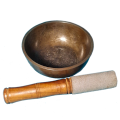
Completing the invitation of the bell, we can give attention to the wooden or metal stick we used to invite the bell, take a mindful breath, and bow in gratitude to the practice. It is as nourishing for the facilitator as it is for the gathered community!
Dharma Sharing
The most nourishing and healing practices involve community. Interactions with members of our birth family, with our life partners, our neighbors, or our Sangha members are where we best observe our habits and the consequences of our actions, and where we refine those actions to become more compassionate and more skillful. Cultivating a space to speak and be heard without judgement allows us to understand more and, understanding, to suffer much less.
A Dharma Sharing
Mindfulness Trainings
Deepening Our Practice (study group)
Present With What Is
These are some ideas for making facilitation a rich experience for the one who is holding the circle.
More important than any of these forms, however, is simply to walk the path of mindfulness. If we feel anxiety or tension in the facilitation, we recognize that we are offering our anxiety and tension to our friends, and let go of this idea or that practice, returning to our breath. By simply sitting mindfully, and inviting the bell, we encourage the community to sit mindfully and listen. The simplest practice is often the best.